Garage Floor Coating in Toronto & the GTA
Flake, epoxy and one-day polyaspartic garage floors that stand up to road salt, hot tires and Ontario winters.
Garage Floor Coating in Toronto: The Short Answer
ConcreteShield installs epoxy, flake and one-day polyaspartic garage floor coatings in Toronto and across the GTA. Installed prices typically run about $5 to $9 per sq ft for epoxy and $12 to $15 per sq ft for polyaspartic. A polyaspartic garage is usually finished in one day. Every floor is diamond ground first, garage floors are indoor residential floors and carry the 10-year warranty, and quotes are free and written after an on-site slab check. Call (519) 778-1412.
A Garage Floor Built for Salt, Slush and Hot Tires
Bare garage concrete soaks up de-icing salt, oil and meltwater, then flakes and cracks through every freeze-thaw cycle. A professionally installed coating seals the slab, so the floor cleans up with a mop and the concrete underneath is protected.
We install garage floors across Toronto and the GTA: a diamond grind, crack and spall repair, a coloured base and a decorative flake broadcast, finished with a clear protective top coat. Our polyaspartic systems are typically finished in a single day.
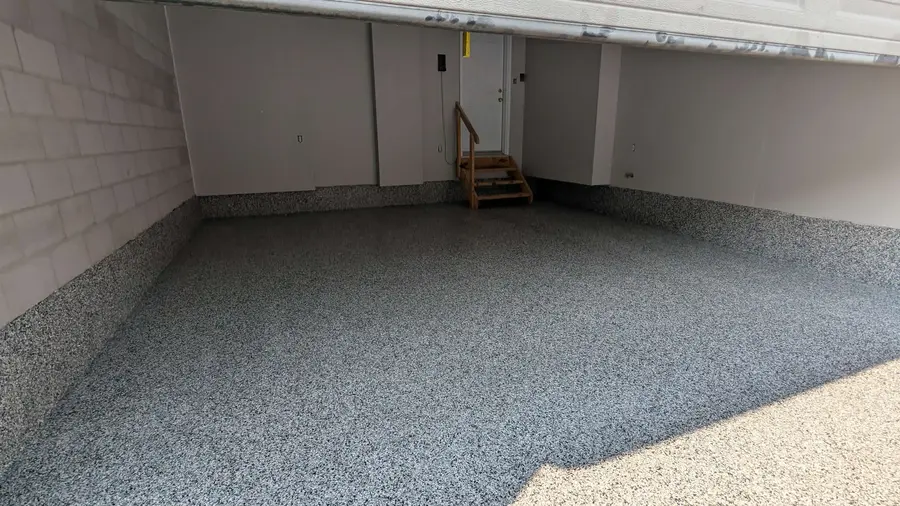
Garage Floor Systems We Install
Flake System
Decorative chip broadcast that hides imperfections and adds natural traction. The most popular garage finish.
Polyaspartic
One-day install, UV-stable and happy in cooler conditions. Ideal as a full system or as the clear top coat.
Epoxy Coating
A thick, durable base for workshops and uneven slabs. Priced from about $5 to $9 per sq ft installed.
Coating a basement, workshop or commercial floor instead of a garage? See our main page on epoxy floor coating in Toronto.
How Road Salt & Hot Tires Damage Garage Floors
The problem
Road salt: every winter, Toronto cars carry salty slush into the garage. As it melts, the brine soaks into bare concrete. When the temperature drops, the water in the surface freezes and expands, and the salt draws in even more moisture. After a few seasons the top layer starts to flake, pit and crumble — the rough, sandy patches you see in front of the parking spot in older GTA garages.
Hot tires: after a highway drive, tires are hot and soft. Park on a thin coating and the heat softens it; when the tire cools and you pull out, it can peel the coating off in tire-shaped patches. This “hot tire pickup” is the most common reason store-bought garage kits fail, along with oil and brake fluid soaking in and staining.
The fix
A properly installed coating stops both. We diamond-grind the slab so the coating bonds into the concrete rather than sitting on top of it, repair existing salt pitting and cracks, then build a non-porous, chemical-resistant floor. Salt water and slush sit on the surface instead of soaking in, so you can squeegee or rinse them out the door.
Because the coating is bonded to ground concrete and built thick enough, it resists hot-tire pickup. A flake broadcast adds texture for traction on wet days, and a UV-stable polyaspartic topcoat keeps the colour from yellowing in sunny garages. Oil and fluids wipe off instead of staining.
Epoxy vs Polyaspartic vs Flake for Toronto Garages
Typical installed ranges for a GTA garage. Your fixed price depends on slab condition, cracks and size.
| Solid colour epoxy | Epoxy flake | Polyaspartic flake | |
|---|---|---|---|
| Installed price | $5–$9 / sq ft | $6–$10 / sq ft | $12–$15 / sq ft |
| Install time | 2–4 days | 2–4 days | Usually 1 day |
| Park the car | After full cure | After full cure | 24–48 hours |
| Cold-weather install | Slab about 10°C (50°F) or warmer | Slab about 10°C (50°F) or warmer | Cures in cooler conditions |
| Look | Sleek, uniform colour | Speckled, hides imperfections | Speckled, UV-stable clear coat |
| Best for | Workshops, budget projects | Most family garages | Fast turnaround, cold months, sunny garages |
| UV / yellowing | Can amber in direct sun without a UV-stable topcoat | Depends on topcoat | UV-stable, won’t yellow |
| Traction when wet | Anti-slip grit included by default on garage floors | Natural texture from flakes | Natural texture from flakes |
Garage Floor Coating Cost in Toronto
Garage floor coating in Toronto is priced by the square foot: about $5–9 per sq ft for solid epoxy, $6–10 for an epoxy flake floor and $12–15 for a one-day polyaspartic system, installed. Applied to typical GTA garage sizes, that works out to:
| Garage size | Solid epoxy | Epoxy flake | Polyaspartic flake |
|---|---|---|---|
| 1-car (about 200–250 sq ft) | $1,000–$2,250 | $1,200–$2,500 | $2,400–$3,750 |
| 2-car (about 400–450 sq ft) | $2,000–$4,000 | $2,400–$4,500 | $4,800–$6,800 |
| 3-car (about 600–700 sq ft) | $3,000–$6,300 | $3,600–$7,000 | $7,200–$10,500 |
These are planning estimates before any crack, spall or slab repair. Heavily pitted floors, old paint or sealers that have to be ground off, and garages with stairs or a lot of edges cost more; open, sound slabs come in lower. You get a fixed written quote after we check your slab, and garage floors are indoor residential floors and carry the 10-year warranty (see the warranty page).
One-Day Garage Floor Coating
If you can't give up your garage for most of a week, a polyaspartic coating is the answer. Polyaspartic cures far faster than epoxy, so the whole system — grinding, repairs, base coat, flake broadcast and clear topcoat — is usually installed in a single day.
- •Walk on it: the same evening.
- •Park on it: after 24 to 48 hours.
- •Cooler weather: it cures in lower temperatures than epoxy, which makes it the usual choice for fall and early-winter garages.
- •UV-stable: it won't yellow in garages that get afternoon sun through an open door.
One day refers to the install, not the prep. The slab still has to be ground, cracks repaired and moisture checked first — skipping that is how “one-day” floors from rushed installers end up peeling. A very damaged slab may need an extra day of repairs, and we will tell you that up front.
Which Garage Floor Suits Your Garage?
How you use the garage matters more than the brochure. These are the situations we see most often in Toronto homes and what we usually recommend.
Daily-driver garages
Cars in and out every day, salt all winter. A flake floor with a tough topcoat is the usual choice: it hides grit and tire marks between cleanings and gives grip when the floor is wet.
Garages that get sun
If the door is open on sunny afternoons, use a UV-stable polyaspartic topcoat. Standard epoxy on its own can amber over time where sunlight hits it.
Workshops and hobby garages
For benches, rolling tool chests and floor jacks, a thicker epoxy base with a chemical-resistant topcoat stands up to dropped tools and spilled fluids. Solid grey also makes small parts easy to find.
Finished and showroom garages
For collector cars or a garage that doubles as a gym or games room, finer flake blends or a solid colour with a higher-gloss topcoat give a cleaner look. Bright floors also make the space feel bigger.
Multi-car and new-build garages
Larger new slabs are often in good shape and coat efficiently, so the per-foot price tends to sit lower. New concrete does need time to cure before coating; we check it before scheduling.
Damp or below-grade garages
Garages built into a slope or under a house can have more moisture in the slab. We test first and use a moisture-tolerant primer where needed, so the coating doesn't lift.
Garage Floor Coating vs Paint, Tiles and Bare Concrete
| How it holds up in a Toronto garage | |
|---|---|
| Professional coating | Bonded to ground concrete; resists salt, oil and hot tires; seamless and easy to clean |
| Garage floor paint or DIY kit | Thin and rolled on without grinding; often peels under hot tires within a season or two |
| Interlocking tiles | No curing time, but salt water and grit collect underneath and in the seams |
| Bare or sealed concrete | Lowest cost up front, but salt and freeze-thaw cause pitting and flaking over time |
A coating costs more than paint or a sealer on day one, but it is the only option here that protects the slab and stays easy to clean for many years. If you love the look of bare concrete, a polished concrete garage floor is another sealed, coating-free option.
Surface Preparation: Where a Garage Floor Succeeds or Fails
Our preparation steps
- Slab check: we test for moisture, look for old sealers or paint, measure slab temperature and map cracks and spalls.
- Degreasing: oil and fluid stains around the parking spot are cleaned out so they don't stop the coating from bonding.
- Diamond grinding: the whole floor is ground to open the pores of the concrete and remove the weak top layer, salt residue and old coatings. Acid etching, used in DIY kits, does not do this reliably.
- Crack and spall repair: cracks are cut open and filled, and salt-damaged areas are rebuilt with a fast-setting repair material so the finished floor is smooth.
- Primer or base coat: the first coat soaks into the ground surface and locks everything together. Slabs with higher moisture get a moisture-tolerant primer.
Why garage coatings fail
- No grinding: a coating rolled onto smooth, unground concrete has nothing to grip and peels within a season or two.
- Contamination: oil, old sealer or salt left in the slab blocks the bond, usually right where the car parks.
- Moisture: water vapour rising through the slab pushes the coating up in bubbles if the slab wasn't tested and primed for it.
- Too thin: one-coat kits and floor paints are a fraction of the thickness of a professional system and wear through or lift under hot tires.
- Wrong conditions: epoxy laid on a cold slab cures badly. We check slab temperature and choose the system that suits the season.
Many older Toronto garages also have years of salt damage or a previous coating that has to be fully removed. That is normal — it just means more grinding and repair, which we include in your written quote.
How a Garage Floor Is Installed
The steps
- • On-site slab check: moisture, cracks, old sealers and slab temperature
- • Diamond grinding to open the concrete and remove contaminants
- • Crack and spall repair with fast-setting filler
- • Coloured base coat and full flake broadcast, or a solid colour
- • Clear protective topcoat with anti-slip grit, included on every garage floor by default
What to expect
- • Polyaspartic garage floors: usually one day, walk on it the same evening, park after 24 to 48 hours
- • Resists road salt, oil, fuel and hot-tire pickup
- • Fixed written quote after we assess the slab
- • Garage floors are indoor residential floors and carry the 10-year warranty (details)
Installation day
For a typical one-day polyaspartic garage, the crew arrives in the morning and starts by protecting the walls and door threshold. Grinding and dust collection come first, followed by crack and spall repairs. By midday the base coat goes down and the flakes are broadcast by hand until the base is fully covered. After it sets, the loose flakes are scraped and vacuumed off, and the clear topcoat is rolled on in the afternoon.
Expect some noise during grinding and a mild odour during coating; we keep the overhead door partly open for ventilation. Epoxy systems follow the same steps spread over two to four days, with cure time between coats. Before we leave, we walk the floor with you and go over when you can walk on it, move things back and park.
Questions to Ask Any Garage Floor Contractor
Garage coatings can look the same on install day and perform very differently two winters later. Whoever you hire, these questions will tell you a lot:
- 1.How will you prepare the slab? The answer should be diamond grinding, not acid etching or just a pressure wash.
- 2.Will you test for moisture? Moisture is a leading cause of lifting and bubbling, especially in older and below-grade garages.
- 3.What are the layers? Ask what goes down as the base, whether flakes are a full broadcast or a light sprinkle, and what the topcoat is made of.
- 4.How are cracks and salt damage handled? Repairs should be included and explained in the quote, not discovered on the day.
- 5.What does the warranty cover, in writing? Look for coverage against peeling and coating loss, and check how long it lasts. Ours is on our warranty page.
- 6.Are you insured, and who does the work? You should know whether the company's own crew or a subcontractor will be in your garage.
Why GTA Homeowners Choose ConcreteShield
500+
Completed floor projects
10 yr
Residential indoor warranty
1 day
Typical polyaspartic garage
Insured
Fully insured, fixed written quotes
What Goes Into a Coated Garage Floor
The layers
A typical flake garage floor has a primer or base coat bonded to the ground slab, a full broadcast of coloured flakes into the wet base, and a clear topcoat that locks the flakes in and takes the wear. Solid-colour floors skip the flakes and use a pigmented topcoat instead.
Epoxy, polyaspartic or both
Some garages get a full polyaspartic system for speed. Others use an epoxy base for build and budget, with a polyaspartic topcoat for UV stability and toughness. We recommend the build based on your slab, your schedule and how much sun the garage gets.
Colours and finish
Flake blends range from greys and charcoals to tans, browns and multi-colour mixes; grey and charcoal blends are the most popular because they hide dust and tire marks. Solid colours come in greys, beige and darker tones. We bring sample boards to your quote.
Caring for your garage floor
Sweep or blow out grit regularly, and in winter squeegee melt water and salt brine out the door instead of letting it dry on the floor. Mop with warm water and a pH-neutral cleaner; avoid acid-based or citrus cleaners. Put a mat under the area where you step out of the car, and use plywood or pads under jack stands and heavy tool chests. A coated floor makes all of this much easier than bare concrete.
Garage Floors and the Cold Season
Standard epoxy needs a slab at about 10°C (50°F) or warmer. Our polyaspartic options cure reliably in cooler conditions, and in deep winter we check slab temperature first and may use temporary heat. If your garage runs colder than that, we schedule around it and confirm the right install window for your space.
Not ready for a garage in January? Heated indoor spaces are not held up by the weather. See our guide to indoor flooring we install through the winter, including basement floors.
Garage Floor Coating Across the GTA
From our base in Etobicoke we install garage floors throughout the region, including Toronto, Etobicoke, North York, Mississauga, Vaughan, Brampton, Oakville, Markham and Richmond Hill. Whether it's a 1950s bungalow garage with decades of salt damage or a new-build three-car garage, you get the same crew, the same prep and the same written quote.
We coat garage floors throughout the GTA, including Toronto, Etobicoke, Vaughan, Markham, Oakville and Caledon. For salt and freeze-thaw background, read our winter and salt guide. See residential project photos or the full residential flooring service. Coating a parking garage, auto shop or warehouse instead? See our mechanic shop floors and warehouse floors.
Garage Floor Coating FAQs
How much does a garage floor coating cost in Toronto?
Epoxy garage floors typically run about $5 to $9 per square foot installed, and fast-cure polyaspartic systems about $12 to $15 per square foot, plus any crack or slab repair. You get a fixed written quote after we assess your slab.
How long does a garage floor coating take?
A polyaspartic garage floor is typically finished in one day, with foot traffic the same evening and parking after 24 to 48 hours. A traditional epoxy system takes longer, usually two to four days.
Can a garage floor be coated in winter?
Often, yes. We install epoxy at slab temperatures of about 10°C (50°F) and above, and our polyaspartic options cure reliably in cooler conditions. In colder weather we check the slab temperature, may use temporary heat, and schedule around very cold spells.
Will road salt damage a coated garage floor?
A cured epoxy or polyaspartic coating resists road salt. It is non-porous, so salt, slush and de-icers sit on top and rinse off rather than soaking into the concrete and causing spalling.
Will hot tires lift the coating?
Properly prepared and installed systems resist hot-tire pickup. Surface preparation is the key factor, which is why every garage is diamond ground before coating.
Is a flake finish or a solid colour better for a garage?
Flake is the most popular choice because it hides small imperfections, adds natural traction and is easy to keep clean. A solid colour gives a sleek, uniform look and suits workshops. We can show you samples at your free quote.
How much does it cost to coat a two-car garage floor in Toronto?
A typical two-car garage of about 400 to 450 sq ft costs roughly $2,000 to $4,000 for epoxy, or about $4,800 to $6,800 for a one-day polyaspartic system, before any crack or slab repair. We give a fixed written quote after checking the slab.
Is epoxy or polyaspartic better for a Toronto garage?
Both work well when the slab is properly ground. Epoxy is the lower-cost option and builds a thick base. Polyaspartic costs more but is usually installed in one day, is UV-stable and cures in cooler weather, which makes it popular for fall and winter garage projects.
Do you offer garage floor coating near me?
If you are in Toronto or the GTA, most likely yes. We are based in Etobicoke and install garage floors across Toronto, North York, Scarborough, Mississauga, Vaughan, Brampton, Oakville, Markham, Richmond Hill and surrounding areas. Call (519) 778-1412 or request a free quote to confirm your address.
Can you coat a garage floor with cracks?
Yes. Cracks and salt-damaged spalls are repaired before coating as part of the job. We grind the cracks open, fill them with a repair material and grind them flush, so they don't show through. Very large cracks or slabs that have shifted may still show a line, and we will tell you that before we start.
How do I prepare my garage before installation?
Move cars, bikes, shelving and anything on the floor out of the garage, and give it a quick sweep. Let us know about any wall-mounted items near the floor. We handle the grinding, cleaning and repairs. Keep the garage clear until we tell you it is ready to use again.
How long does a garage floor coating last?
With proper grinding and prep, a professionally installed epoxy or polyaspartic garage floor typically lasts 15 years or more in a home. The clear topcoat takes most of the wear, and it can be refreshed later if busy areas start to dull. Garage floors are indoor residential floors and carry the 10-year warranty.
Will a polyaspartic garage floor turn yellow?
No. Polyaspartic is UV-stable, so it keeps its colour in garages that get direct sun. Standard epoxy can amber over time in sunlight, which is why we use a polyaspartic topcoat in sunny garages even when the base is epoxy.
Can you coat over existing garage floor paint or an old coating?
Not directly. Old paint, sealers and failing coatings are ground off first, because a new coating is only as strong as what it is bonded to. Removing them adds some time, which is included in your written quote.
Is a coated garage floor slippery?
A flake floor has natural texture and good grip, even with some melt water on it. Anti-slip grit is included in the topcoat on every garage floor by default, so solid-colour floors get grip too. Squeegeeing out slush in winter also keeps the floor safer.
Which areas do you install garage floors in?
We install garage floors across Toronto and the GTA, including Etobicoke, North York, Scarborough, Vaughan, Woodbridge, Maple, Kleinburg, Markham, Richmond Hill, Aurora, Newmarket, King City, Nobleton, Oakville, Bolton and Caledon.
Get a Fixed Quote for Your Garage Floor
We will check your slab, show you colour samples and give you a fixed written quote anywhere in the GTA.