Concrete Floor Repair in Toronto & the GTA
Cracks, pitting, salt damage and peeling coatings fixed properly, so your garage, basement or shop floor is sound again and ready for a coating that lasts.
Concrete Floor Repair in Toronto: The Short Answer
ConcreteShield fixes cracked, spalled and salt-damaged concrete in garages, basements and commercial spaces across Toronto and the GTA. We diamond grind, fill cracks, rebuild pitted areas and remove failing coatings, then protect the slab with a new coating. Work is quoted after a free on-site check. Call (416) 477-4272.
Concrete Floor Problems We Fix
Cracks
Shrinkage cracks, settlement cracks and cracks along control joints. We cut them open, clean them out, fill them and grind them flush so they don't telegraph through a new coating.
Spalling and Salt Damage
The rough, flaking patches in front of the parking spot in older GTA garages. Loose concrete is ground back to a sound surface and rebuilt with a fast-setting mortar.
Pitting and Pop-Outs
Small craters where stone or surface paste has broken away. They are filled and levelled so the finished surface is smooth and easy to clean.
Peeling Epoxy and Paint
DIY kits, floor paint and coatings that were rolled on without grinding. We remove the failing layer completely before recoating.
Uneven and Low Spots
Worn traffic lanes, old patches and low areas that hold water. We grind high spots and build up low ones before coating.
Oil-Soaked Concrete
Oil and fluid stains that have soaked in under the car. They are degreased and ground out, because contamination is one of the most common reasons coatings lift.
Why Concrete Floors Crack and Flake in the GTA
Most of the damage we see comes from the same few causes. Knowing which one you have decides how the floor should be fixed.
Road salt and freeze-thaw
Every winter, cars carry salty slush into Toronto garages. The brine soaks into bare concrete, freezes and expands, and the salt pulls in more moisture. After a few seasons the top layer starts to scale and flake. Filling the damage is only half the job; sealing the slab with a non-porous coating is what stops it happening again. Our winter and road salt guide explains this in more detail.
Shrinkage and settlement
Almost every slab develops some cracks as it cures and shrinks. These are usually stable and fill well. Cracks where one side has dropped, or that keep getting wider, point to movement under the slab and need a closer look before we commit to a fix.
Moisture from below
Basements and below-grade garages often have moisture moving up through the slab. It shows as dark patches, white powder (efflorescence) or coatings that bubble and lift. We test for moisture on-site and choose a moisture-tolerant system where it is needed. See our guide to slab prep and moisture.
Coatings applied without grinding
A coating rolled onto smooth or acid-etched concrete has very little to grip. Add hot tires and oil, and it peels within a season or two. Fixing that floor means removing the old coating first, which is why we never coat over a failing layer.
How We Repair a Concrete Floor
- On-site check. We map cracks and spalls, look for old coatings and sealers, check slab temperature and test for moisture.
- Remove what's failing. Peeling coatings, paint and loose concrete are ground off until we reach a sound surface.
- Diamond grinding. The whole floor is ground to open the concrete, remove salt residue and contamination, and give the filler and coating something to bond to.
- Fill cracks. Cracks are chased open, vacuumed out and filled, then ground flush with the floor.
- Rebuild spalls and pits. Damaged areas are rebuilt with a fast-setting mortar and levelled.
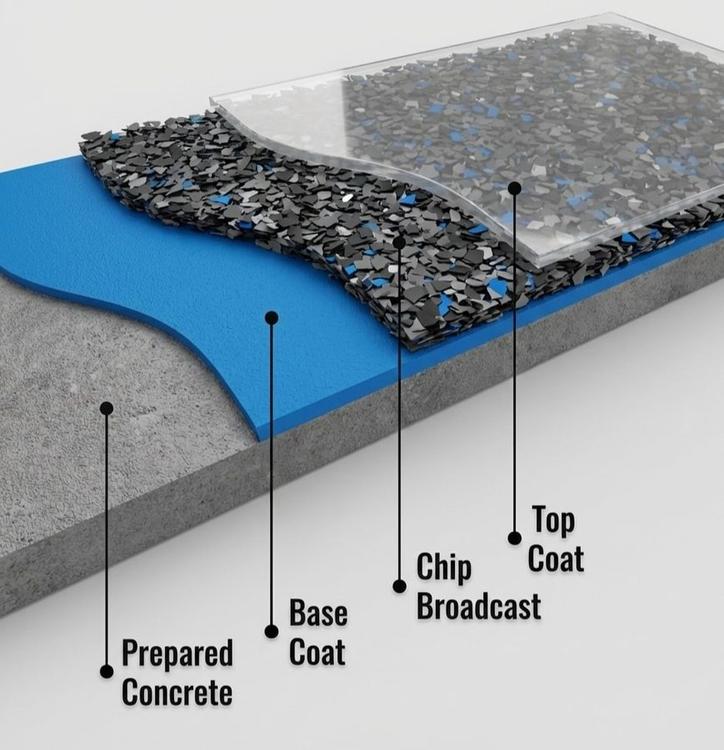
- Protect the slab. A coating such as epoxy, a flake system or one-day polyaspartic seals the finished slab so salt and water stay on the surface.
In a typical garage, grinding and patching are done in the morning and the coating goes down the same day. Heavily damaged slabs can need an extra day, and we tell you that up front in the written quote.
Repair, Resurface or Replace?
| Floor condition | What usually works |
|---|---|
| Hairline and shrinkage cracks | Fill, grind flush and coat |
| Salt scaling and pitting | Grind to sound concrete, rebuild low areas, coat to stop further damage |
| Peeling epoxy, paint or sealer | Grind the old layer off completely, repair, then install a new system |
| Moisture, efflorescence or lifting | Moisture test, then a moisture-tolerant system such as polyurethane cement |
| Heaved, sunken or broken-up slab | Often needs concrete replacement first; we will tell you honestly if a coating isn't the right fix |
Most garage and basement slabs we see fall into the first four rows and are fixed and coated in place, without tearing out concrete.
Garage, Basement and Commercial Floors
Garage floors
Garages take the worst of it: salt, slush, hot tires and oil. Fixing the slab and then coating it is the most common job we do. See our garage floor coating page for systems and prices.
Basement floors
In basements the work focuses on cracks and moisture. Every basement is moisture tested before coating. See basement floor coating.
Shops, warehouses and restaurants
Worn traffic lanes, damaged joints and spalls under forklifts or carts. We fix and recoat on evenings or weekends where needed. See warehouse floors and mechanic shop floors.
Questions to Ask Before Hiring a Contractor
- Will you grind the floor, or just patch the damaged spots?
- Will you test for moisture before repairing or coating?
- What filler will you use, and will it be ground flush?
- Is the crack and spall work listed separately in the written quote?
- What does the warranty cover once the floor is coated? (Ours is on the warranty page.)
- Are you insured, and who will actually do the work?
Concrete Floor Repair Across the GTA
From our base in Etobicoke we work in Toronto, Etobicoke, North York, Scarborough, Mississauga, Vaughan, Brampton, Oakville, Markham and Richmond Hill, plus Woodbridge, Maple, Kleinburg, Aurora, Newmarket and surrounding areas.
Concrete Floor Repair FAQs
Do you repair concrete floors in Toronto?
Yes. We repair cracked, pitted and salt-damaged concrete floors in garages, basements and commercial spaces across Toronto and the GTA. Every job starts with an on-site check so we can tell you what caused the damage and which fix will last.
Can a cracked garage floor be repaired?
Yes. Most garage floor cracks are cut open, cleaned out, filled and ground flush. Hairline and shrinkage cracks repair well. Cracks where the slab has shifted or one side has dropped may still show a line, and we will tell you that before we start.
How do you repair spalled or salt-damaged concrete?
We grind away the loose, flaking surface until we reach sound concrete, then rebuild the low areas with a fast-setting mortar and grind it level with the rest of the floor. Coating it afterwards stops road salt from soaking in and causing the same damage again.
Can you fix a peeling epoxy garage floor?
Yes. Peeling epoxy usually means the floor was not ground before it was coated, or moisture or oil was trapped underneath. The failing coating has to be ground off completely, the slab fixed and tested, and then a new system installed. Patching over a peeling floor just moves the problem.
How much does concrete floor repair cost?
The price depends on how many cracks there are, how deep the spalling goes and whether an old coating has to come off, so we quote it after seeing the floor. When this work is part of a coating job, it is listed separately in your fixed written quote. Coating prices are on our garage floor page.
Should I repair my concrete floor before coating it?
Always. A coating follows the surface underneath, so cracks, pits and loose concrete show through and can cause the coating to fail early. This prep is included in every coating job we do, after diamond grinding and before the first coat goes down.
Can you repair concrete floors in winter?
Indoor floors such as basements and heated garages can be fixed all year. In unheated garages we check the slab temperature first and use fast-setting materials and, where needed, temporary heat. Very cold spells may move the date by a few days.
Will a repaired crack come back?
If the crack was caused by shrinkage or old damage and the slab is stable, a properly filled crack usually stays closed. If the slab is still moving, a fine line can reappear over time. We look for movement during the on-site check and explain what to expect.
Do you repair commercial and warehouse floors?
Yes. We fix cracks, joints, spalls and worn areas in warehouses, shops, restaurants and offices, usually as part of a new coating. We can schedule work for evenings or weekends so the space is back in use quickly.
Which areas do you serve for concrete floor repair?
We are based in Etobicoke and work across Toronto, North York, Scarborough, Mississauga, Vaughan, Brampton, Oakville, Markham, Richmond Hill and surrounding GTA areas. Call (416) 477-4272 to confirm your address.
Get Your Floor Checked for Free
We will look at the cracks and damage, test the slab and give you a fixed written quote anywhere in the GTA.
Book a Free Quote