DIY Epoxy Kits vs. Professional Installation: What's the Real Difference?
A lot of homeowners start with a hardware-store kit before calling us. Here are 9 honest answers on what's actually different between DIY and professional-grade epoxy.
9 Questions About DIY Kits vs. Professional Commercial Grade
What's actually different between a hardware-store garage kit and professional epoxy?
Hardware-store kits are typically thin 1-part acrylic or light 2-part epoxy — a fraction of the thickness of a professional system — so they wear through in months instead of years. Our epoxy coating system uses commercial-grade materials applied at proper mil thickness.
Will a DIY kit hold up in a garage that sees daily vehicle traffic?
Most DIY kits aren't rated for daily tire traffic and start showing hot-tire marks, peeling, and delamination within a year. A professionally installed flake system is built specifically to handle daily vehicle use.
I put down a DIY epoxy kit and it's already peeling — can a pro fix over it?
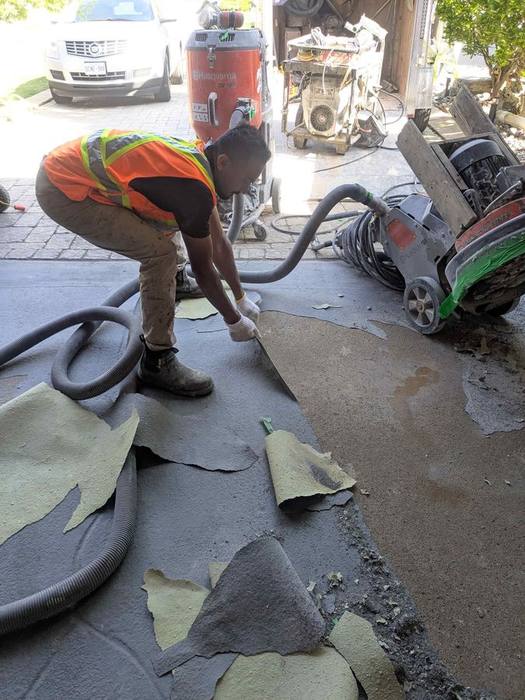
In most cases, yes — but the failed coating has to be fully ground off first rather than coated over, or the new epoxy will fail the same way. Our residential team handles this removal-and-recoat process regularly.
Is it worth grinding out an old DIY coating before hiring a professional?
It's necessary, not optional — epoxy only bonds properly to a mechanically profiled, contaminant-free slab. Our concrete polishing and grinding process preps the surface properly before any new coating goes down.
What's the real lifespan difference between DIY and professional-grade epoxy?
DIY kits typically last 1-3 years before visible wear; a professionally installed system lasts 10-20 years with proper care. That's reflected in our warranty terms, which only apply to professional-grade installations.
My DIY epoxy is peeling. Is the concrete ruined?
No — peeling almost always means the coating failed to bond, not that the concrete underneath is damaged. Once the old coating is ground off, the slab is usually in fine shape to recoat properly. Book a free consultation and we'll assess the slab before quoting a fix.
Can I just paint over my peeling DIY epoxy floor?
No — painting or recoating directly over a peeling surface just traces the same failure into the new layer, since epoxy needs to bond to bare, mechanically profiled concrete, not to another coating. The failed layer has to be ground off first, which our concrete grinding and polishing process handles before any new coating goes down.
Do professional installers use the same epoxy kits I can buy at the store?
No — hardware-store kits are typically thin, single-coat, water-based formulas built for easy DIY application, while professional-grade epoxy is a thicker, solvent- or 100%-solids system applied in multiple coats at a much greater mil thickness. That thickness difference is the main reason professional floors last 10-20 years instead of 1-3.
My DIY kit is bubbling. What did I do wrong?
Bubbling is almost always trapped moisture vapor pushing up through the coating, or air trapped during roller application — both common issues when a slab isn't tested for moisture and properly prepped first. Our polyurethane cement and moisture-tolerant systems are built specifically to prevent this on slabs where it's likely to happen again.
When a DIY Kit Isn't Enough
A DIY kit can work on a small, dry residential slab. It's the wrong choice anywhere the floor takes real abuse: gyms with dropped weights, or auto shops with hot tires and fluids. If a kit floor is already peeling in your garage in Scarborough, Richmond Hill, Woodbridge or Maple, we can strip it and install a proper system. If you're unsure, our residential flooring page explains what a professional system includes.
Browse Other Topics
Skip the guesswork with our professional garage floor coating in Etobicoke, Vaughan and Toronto, or read about epoxy coatings.
Still Have Questions?
Already tried a kit, or still deciding? Book a free visit and we'll look at the floor and tell you honestly what it needs.